
My kids do not look like me. I mean, there are some traces of the fact that I am, in fact, their mother. Their big smiles, long eyelashes, and the stubborn cowlick on the right side of their heads bear witness to the fact that it was indeed I who carried them around for nine months while they ninja-kicked my bladder. Overwhelmingly though, they favor their father.
When my oldest was born, I was sort of in denial about how much he did not look like me. As we had more kids, I kept expecting the next one would look more like me. Then, as more Stephen Schuch clones marched from my womb, I at least began to be resigned to the fact that my genes were impotent. The doctor would hold up the screaming newborn that looked like a carbon copy of my previous screaming newborn and I would just sort of nod and think, “Yep. That’s my Schuch baby.” I basically had childbirth deja vu five times.
While I am now mostly resigned to my weak gene lot and hello, these Stephen clones are adorable, there is still sometimes something somewhat sad about having children that don’t resemble me at all. We expect our children to look like us. It feels meaningful that they look like us. It feels surprising when they don’t.
Eleven years into parenting now and I’m having this feeling in different, but still similar ways.
You see, I was a pretty good kid. When I look back on my childhood, I remember being pretty easy and peaceful and compliant. I remember mostly wanting to follow the rules and do well and please my parents. I remember loving the Lord about as early as I could understand who He was. I promise I’m not just painting a rose-colored picture of myself. I have confirmed with my parents that this was really mostly the case. Let it be known though that I was not without flaws. See: my penchant for laziness and escaping chores at all costs.
If you’d asked me when I had kids if I expected them all to follow exactly in my footsteps, I would’ve said no because that is the sensible, realistic answer. Yet, I think deep down, I sort of did. I knew parenting was hard. I knew my kids would be sinners, but they would be my kids. Just as I expected them to look like me, I also sort of expected them to be like me. If I dug deep on why I expected this, I’m sure I’d find something of pride, something of an affront to my ego. But perhaps, there’s even more to it.
We’re told in the first chapter of Genesis that God created man and woman in his image.
Then God said, ““Let us make man in our image, after our likeness. And let them have dominion over the fish of the sea and over the birds of the heavens and over the livestock and over all the earth and over every creeping thing that creeps on the earth.” So God created man in his own image, in the image of God he created him; male and female he created them.” Genesis 1:26-27
It’s repeated three times in different ways which tells us that it’s pretty important. What it means, exactly, is a little more complicated. Most obviously, it means that we were made to look like God, to resemble him and to be “genetic carriers” so to speak, of his attributes. It means more than that though.
In the ancient near East, the idea was commonly used to indicate those who were the visible representative of the deity and ruled on his behalf. Image is clearly linked to dominion. God creates man in his image and then sends them out to rule the earth and be his representatives who accomplish his work and spread his glory. Commanded to be fruitful and multiply, Adam and Eve were commanded to spread his image across the earth. Parenting, you see, was always intended to be about the image of God.
Instinctively then, we know that image matters. As it was intended, this instinct leads us to want to represent the image of God in all of life including our parenting. With the introduction of sin, this instinct becomes warped and leads us to focus on representing our image in all of life including our parenting. Instead of seeing parenting as an opportunity to raise children created in the image of God for the glory of God, in our pride, we can see it as an opportunity to raise children created in our image for our own glory. Imago Dei is traded for Imago Mei.
As some of my parenting frustrations have mounted, I’ve been forced to sit with my expectations and examine. Be wary of examining as it doesn’t always turn up pretty things. As I dug around in my thoughts and feelings, I began to realize what was at the core of much of my frustration with my kids’ behaviors. As I vented to myself about some of their struggles and sin patterns, I would find myself thinking, “I wasn’t like this. I was _____.” Fill in the blank with some example of my superior child-ing. As these thoughts continued to circulate in my mind, I realized that I wasn’t always really upset about my children’s sin because it was an affront to God, but more because it was an affront to me and my expectation that my children would be like me. I was often more upset about the way they would make me look and reflect on me.
I wanted them to be made in my image.
And just like that, I went from a concerned mother to a God-usurper in sixty seconds.
Isn’t that really what happened in Genesis 3? Those who were created to reflect and spread the image of God became more enchanted with the image of self. From the garden on, mankind has been trying to take dominion of the earth in order to build their own kingdoms. They’ve been fruitful and multiplied, but often for the purpose of gaining power and glorifying themselves through their own little image bearers.
But when we reframe parenting through the lens of Genesis 1, we start with stewardship, not ownership. We don’t even own our own image. Rather, we steward the image of God for the spread of his renown. We don’t own our children as imprints of ourselves sent off to work our will and bear witness to our glory. Rather, we steward them as fellow image bearers of God and we raise them up to be imprints of his character, sent out to bear witness to his glory.
And that changes a lot. It changes the way we respond to their struggles. It changes the way we think about them. It changes our motives for trying to help them change. It changes the way we pray for them. If we start with that, it changes everything.
My kids don’t look like me, but maybe that helps remind me that was never the goal. And what a small goal it would be. A little like constructing my own toothpick houses when I could have played a role in the building of Versailles.
So, as we press forward in the sometimes-onerous work of parenting, let’s keep the call of Genesis 1 in view. Let’s not trade the glory of Imago Dei for the insignificance of Imago Mei.
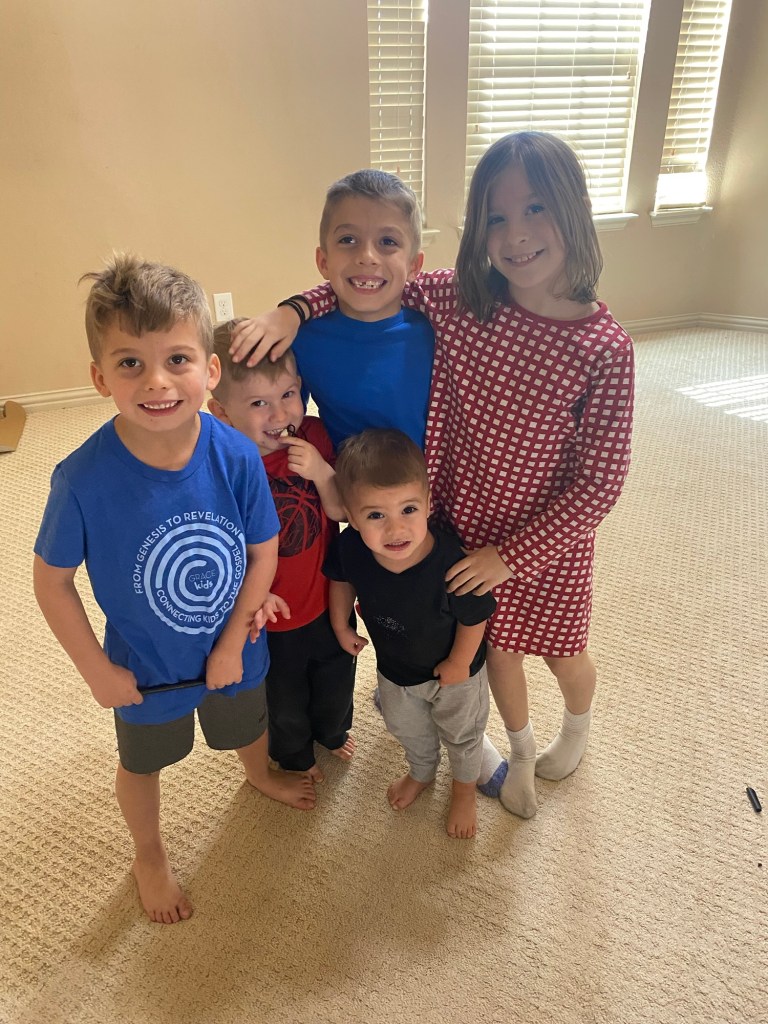
Here’s a recent pic of 5 out of 6 husband clones.
 The Motherhood Marathon