
New on substack today! Mom guilt gets a rebrand.
Author: emilyschuch
I was born and raised in Oklahoma. I graduated from the University of Oklahoma in 2011 with a B.A. in Philosophy. Go Sooners. I'm a stay-at-home mom to two precious little ones. I like Jesus and words and when I find the time and the brain power, I like to use my words to talk about Jesus.
The Necklace of Faitfulness
This morning’s newsletter talks about how ordinary days add up to a meaningful life. Read and subscribe below and follow me on IG @emilysschuch to stay connected with more of my writing
https://open.substack.com/pub/emilyschuch/p/the-necklace-of-faithfulness?r=1q40ee&utm_medium=ios
New newsletter!
As many have been telling me, having a newsletter is pretty important for writers, so I have *finally* set one up.
Rooted will be a monthly-ish newsletter continuing to share much what I’ve shared here. I will still try to post on here as well, but if you enjoy reading my writing please consider subscribing. It’s a great way to support an author and I’d be really grateful!
Here is the link
When His Love Feels Like Death

“Now Jesus loved Martha and her sister and Lazarus. So, when he heard that Lazrus was ill, he stayed two days longer in the place where he was.”
I read the story of Lazrus the other day and there was so much that stood out to me, but most particularly this verse. You can tell John dropped it in there knowing it would make the reader sit up in his seat. Jesus loved Mary and Martha and Lazarus so…. You think it would say, “So, he rushed to be there and keep Lazarus from dying. But it doesn’t it says, “So, he delayed. Because He loved them, He delayed.
If love is desiring someone’s highest good, John is saying that it was Lazarus’s highest good…to die.
Sometimes, it feels like God’s delays are not love, but death. Sometimes, we don’t understand how he can still be good when our hopes lie buried or we suffer in this life. The crowd expressed these doubts. “Could not he who opened the eyes of the blind man also have kept this man from dying?” And you know what? The answer was “yes.” Jesus could have kept Lazarus from dying, but he deliberately chose not to. It was better not to.
His love doesn’t always make sense to us.
And yet…we can trust Him. Why? Because Jesus stood before our grave and decided to go in. He looked at the hold death had on us and traded places to free us.
Martha, who kind of gets a bad rap, makes a beautiful confession of faith in Christ even while her brother’s body was still in the grave. “I believe that you are the Christ, the Son of God.” She believed…even if…even though…
We can make the same confession. We can trust even when his love feels like death because we know Him. And we know that in Him, resurrection always waits on the other side.
Bounty From Bankruptcy
The baby didn’t sleep well last night which always leaves me feeling anxious, wondering how I will face the day of diapers and chores and sibling fights without adequate rest. The demands of the day often feel so great and I often feel so not enough to meet them.
But I sat down with my coffee this morning, trying to grab some restoration through caffeine and a few minutes in the word while a child squirmed on my lap. We read the story of Jesus feeding the five thousand and it helped me remember: God is often more interested in working through our lack than through our plenty.
We have an idea that God wants us to bring Him our strengths and resources and talents so He can use us, but actually God especially loves to use our weakness and need. He loves meeting great demand through “not enough” people. He loves to create bounty out of bankruptcy.
We can face the day of great demands because we have the God of great grace.
But some coffee probably won’t hurt either.
How to be the Best Mom
Happy Mother’s Day friends. Like me, I hope you’re getting some time away with no one asking you for snacks or to wipe their butt. Unlike me, I hope you didn’t have to clean applesauce off your bedroom carpet last night…
It’s been 3 weeks since my book released and if you haven’t, I hope you’ll grab a copy. It’s a strange thing to write a book on motherhood because at least in some way, you are setting yourself up as a kind of authority on the subject. “Author” is, after all, the root of the word “authority.” I’ve questioned a lot if I’m worthy of that title…if I’m a good enough mom.

It’s a question that often swirls in my mind and I suspect in the minds of others. Am I a good mom? Am I good *enough*? Have I done just enough to fall into the category of “good” and escape the category of “bad?” The problem is that perhaps I am good enough one day, but fail miserably the next. Trying to be good enough feels like trying to climb a muddy slope, advancing 5 feet only to slide back 20 and then try, try, try again. And this is why motherhood keeps us very close to our need for the Gospel.
It shows that there is actually something quite wrong with us and not in the simple sense that we sometimes make mistakes, but something wrong at our very core. We have an unshakeable sense of an external standard and a disquieting knowledge that we have not met it. What we are is not what we “should” be. Try as we might, we can never be good enough because there is no good enough. In and of ourselves, we can never reach the top of the muddy slope.
The Gospel of grace changes the questions. While we are wondering, “good or bad,” it is asking “in or out?” The only categories it is concerned with are “dead in sin” or “alive in Christ.” And the difference between the two is not just enough grit to climb the top of the hill, but the sovereign hand of God which has picked us up and placed us there. Trying to merit grace is like climbing back down the hill to slide around in the mud some more.
The irony is that the “good” mom, the best mom will be the one who sits atop the hill she didn’t climb and rests in the favor she didn’t earn, content to simply be “in Christ.” For In Christ, we have been renamed, not good or bad, but “mine.” In Christ, there is an abundance of mercy and grace and love for moms who have fallen short. And that…is very good news.

In other exciting news, e welcomed Shiloh Stephen 6 weeks ago. Life with 6 kids is…just about as chaotic as you would imagine…but equally as rich. I am so thankful for these gifts.
New book out now!
I courteously waited til after Taylor Swift dropped her new album so as not to steal her thunder. But actually…I just found out yesterday. “Majoring in Motherhood” is OUT NOW.
I started writing this book over five years ago so in many ways, this feels like the birth of my longest carried baby. It’s also sort of poetic that it is coming out now, when I’m in the throes of newborn life and overwhelm (literally pumping as I write this).
I’ll have more to share about the book soon, when there’s not so many little people asking me what’s for dinner, but for now I’ll just say, I hope it blesses you.
The first 30 days of a book are crucial so if you read and enjoy, please leave a review and share with a friend!
Already Warriors
There is an idea that traditional femininity is weak and outdated, that for women to be strong, we have to be just like men. Women who tend the home, who nurse and nurture know nothing of battle.
I beg to differ.
Moses’s mother, in fierce maternal protection, defied a ruler. In the simple act of nursing her son, she nursed a rebellion against her people’s oppression. She raised up the one whom God would raise up to be their deliverer.
Mary, in simply submitting her body to shelter and grow a baby, became the mother of the Messiah, the vessel of the lion of Judah who would defeat our greatest enemy. Thus, she opened her mouth not to sing a lullaby, but to speak of casting down thrones and scattering the proud.
“The wise woman builds her house,” and she builds in quiet, but mighty subversion. She pushes back darkness with the light of love and grace. She raises the sword of truth to teach and admonish and train. She tends and nurses and nurtures, and she does so as an act of war against powers and principalities.
Who knows what seeds planted in the soil of our homes God may grow to work His will? We don’t have to spurn femininity to be strong. We must wield it. We don’t have to go far to fight. The battle is here. And we are already warriors.

Cover reveal
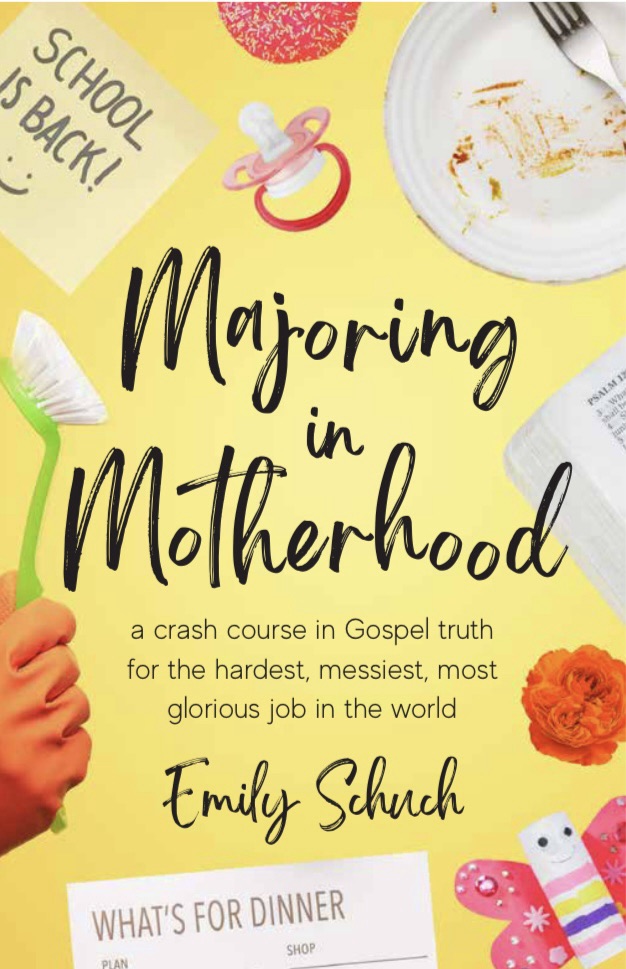
I’m excited to share the cover for my book! The last main hurdle before release is getting some helpful endorsements. Hoping it will be out by Mother’s Day!
Do Not Grow Weary
I swear sometimes I am tired from the day before it has begun. I’ll sit here for a few moments in the morning, sighing as I brace myself for what I know is about to come: another endless carousel of dishes and laundry, sibling fights resolution, a hundred wipes of butts and runny noses, painstaking explanation of object of the preposition and carrying the one.
This is all good I am doing. It is good work. Yet sometimes goodness wears on you. “Good” is not a word that evokes much excitement. In our writing curriculum, it’s a banned word because it’s boring. We are more apt to honor the great life, not the good one. Perhaps, that is why Paul commanded, “Do not grow weary in doing good.” He knew continual, simple, mundane good-doing could make you weary. And yet, he also promises that it is this goodness that will be the most fruitful. “In due season we will reap, if we do not give up” (Galatians 6:9).
It has been about ten years exactly since I found out I was pregnant with Gideon and now, sitting here pregnant with our sixth, I’ve been reflecting a lot on the past decade. It has been a decade of giving up my body, my sleep, endless wiping, endless lunch-making, endless laundry and menial work. It has been a decade of daily good-doing. And it has often made me weary. But I also look up now and I’m sort of amazed at what God has brought from it all. I see the glimpses of harvest, of fruit budding on the trees, fed by a decade of simple, uninteresting daily good.
We can look back and look forward so we will not grow weary in doing good. The harvest is coming. The harvest is here. Do not give up.

 The Motherhood Marathon